Design & Technology · Naval architecture
Fat birds
don’t fly
It was the first rule Morrelli & Melvin gave the project. Every line of PB72 still answers to it.
“What if we tried this again? … Just start from scratch.”
The designers
Morrelli
& Melvin
From Newport Beach, California, Gino Morrelli and Pete Melvin have drawn America’s Cup yachts and many of the fastest catamarans ever built. They also designed the original Extreme H2O.
For PB72 they had something rare: a client with a decade of data from his previous boat, a willingness to start over, and a scientist’s appetite for simulation. The brief was not a faster version of the old boat. It was the boat the old one pointed to.
The engineer on PB72 is Ferdinand van West, who worked with Pat and Pete Melvin from the first conversation in Sarasota to the final general arrangement.

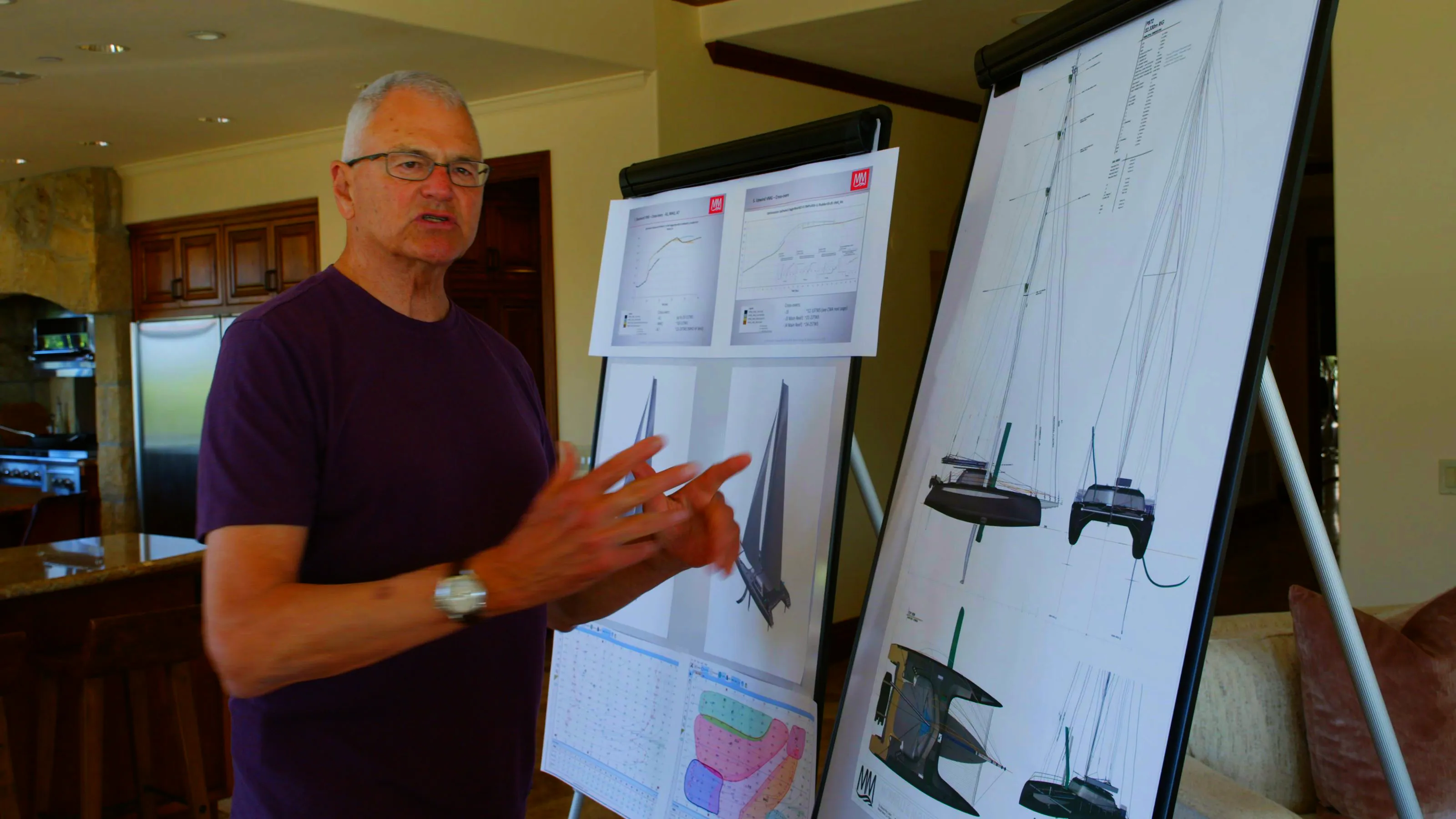
Proportion
Proper proportions
of hull and rig
To balance the boat for speed and keep the same saloon as the original, she had to grow to 72 feet, with a waterline close to her full length, a wider beam, and the mast moved back to the top of the cabin roof. Below foiling speed, a boat is fastest when her full length is in the water, so the hulls were proportioned to keep a full-length waterline at low speed; once she is on the foil, that no longer matters. Comfort was never allowed to dictate shape. The hulls stay long and fine; the cabin sits low and well aft, its roof doubling as the base for the boom so the mainsail sheets straight down onto the structure.
Aerodynamics
Shaped
by the air
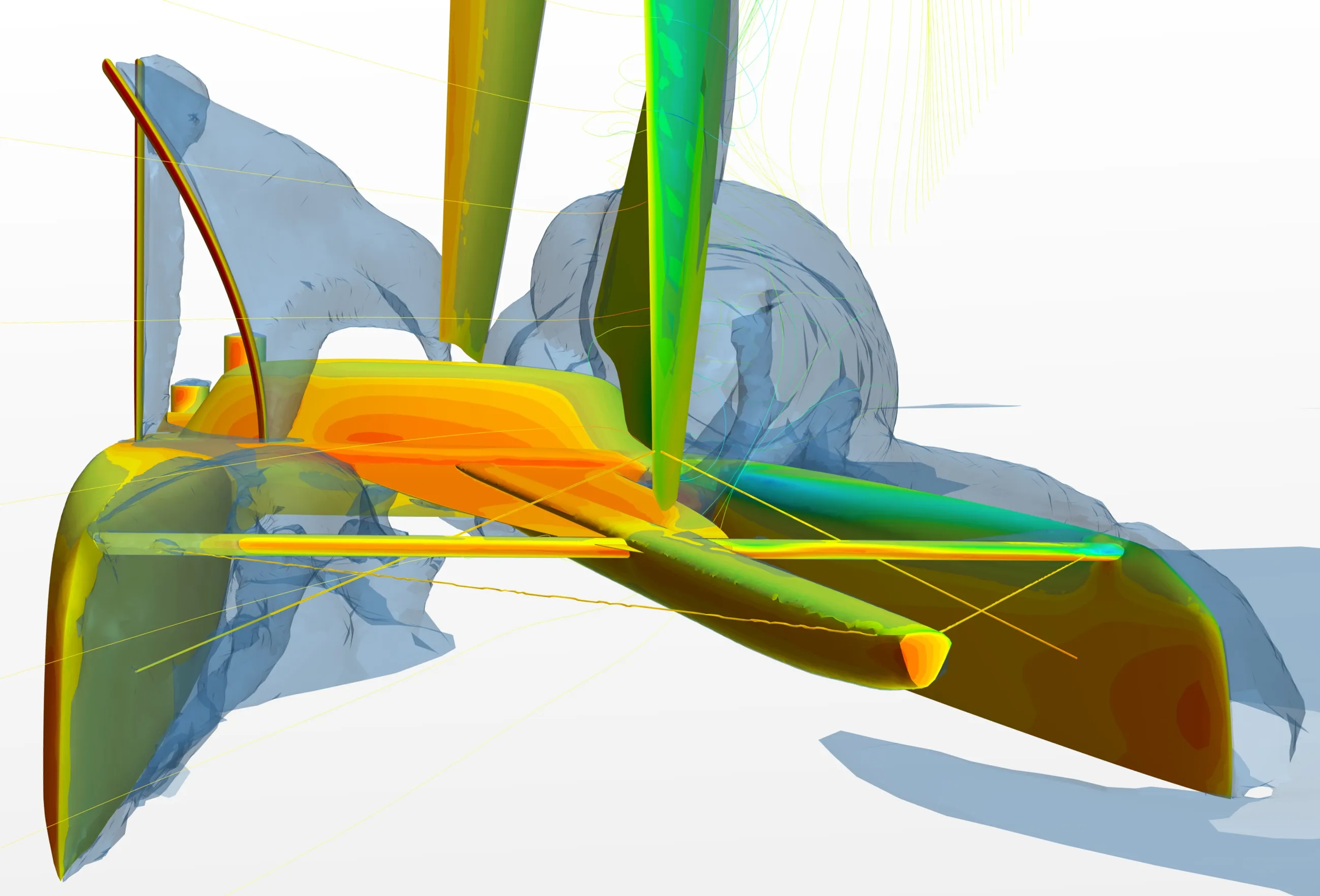
The cabin front is shaped like an aircraft windscreen. At foiling speed the apparent wind can top forty knots, and every square metre of frontal area costs speed.
So the air was modelled as carefully as the water. Computational flow simulations traced how it moves over the hulls, cabin, beams and rig.
Designed in simulation
A digital
ocean
“Designing a yacht like this requires you to sling out the textbook. The concepts don’t exist in old drawings or handed-down rules of thumb.”
Ferdinand van West · Seahorse, July 2025
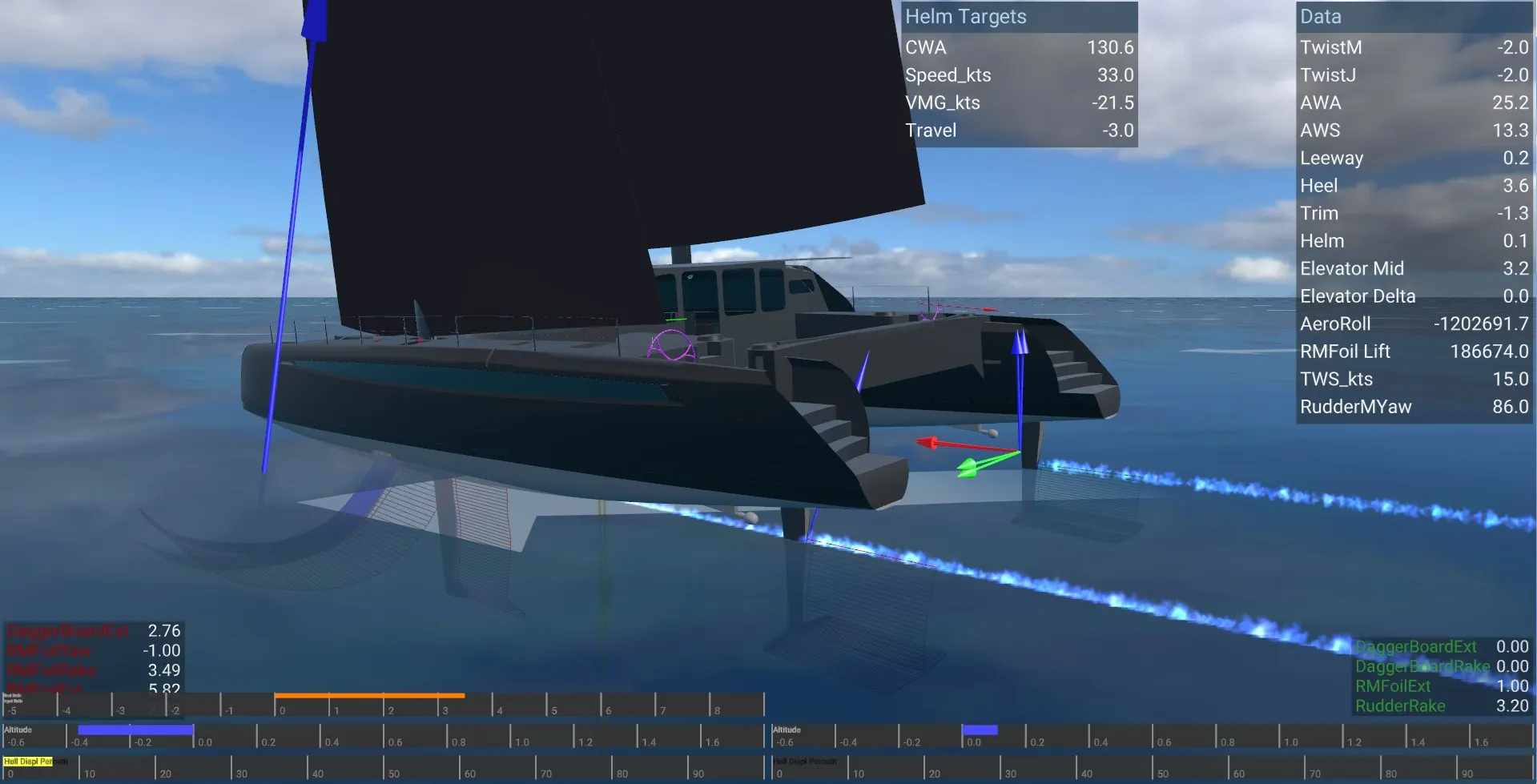
Gomboc · Dynamic VPP
PB72 was sailed thousands of times before she was built, in Gomboc, the dynamic velocity-prediction program developed by SumToZero and used by Emirates Team New Zealand. Foil shapes, hull shapes and sail configurations were tested and refined in simulated wind and waves.
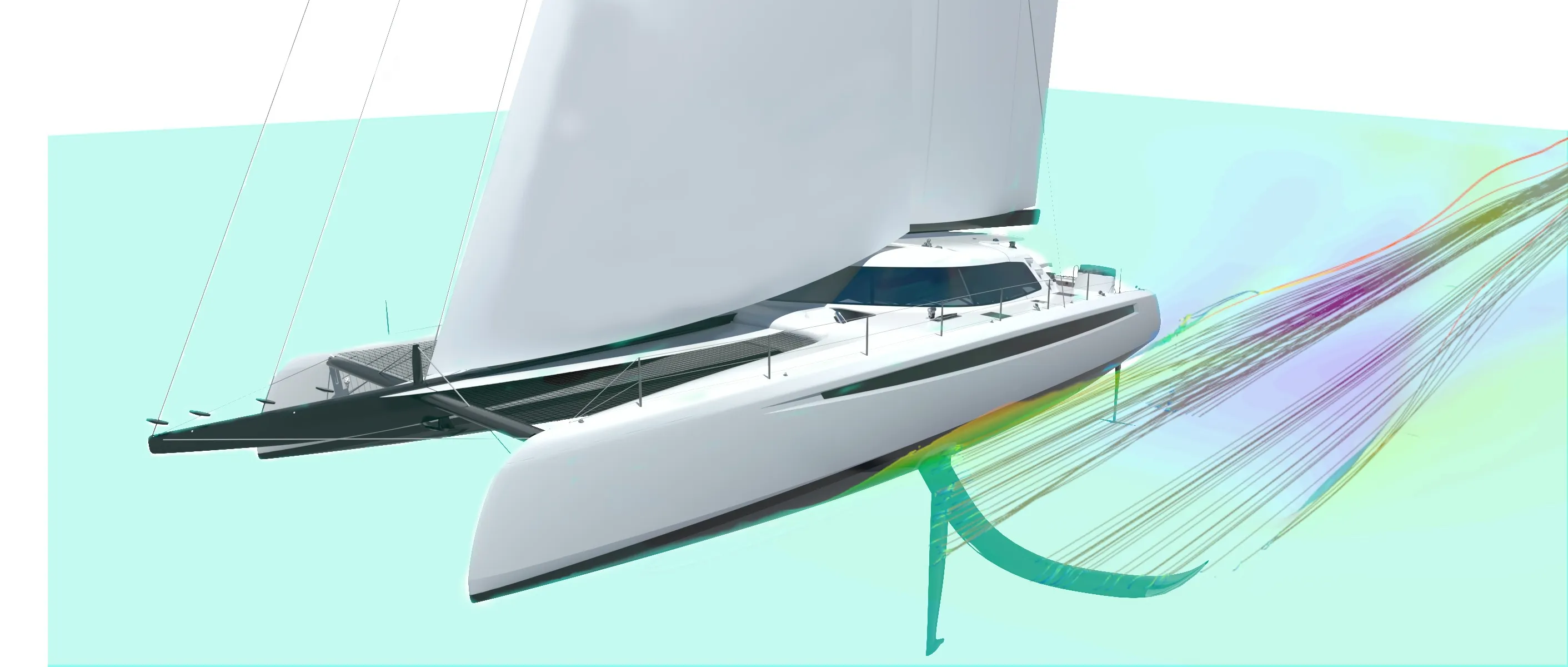
CFD · Hydroflow
A CFD simulation of PB72 semi-foiling upwind at a predicted 26 knots, showing how the water moves around the hull, the righting-moment foil and the rudders. Upwind foiling is still to be tested in sea trials.
“Four giant hydraulic winches… each one can hold like twelve tons.”
Deck layout
Everything
led aft
Halyards come down the mast and run through tunnels in the cabin roof to a stand behind it. Every sheet comes to one of four hydraulic winches, two each side. The result is a 72-foot catamaran that a crew of four on each watch can sail fast, and nobody has to go forward at thirty-five knots.
Rig
A 32-metre
carbon mast
- Mast tube
- 32.33 m
- 4° design rake
- Mainsail
- 224 m²
- Three reefs
- J1
- 196 m²
- A1 gennaker
- 365 m²
- Air draft
- 37 m
The drawings
Side and
front views
The rig towers over two slender hulls; from the front, the curved foil reaches out to leeward. Click either drawing to see it full screen.
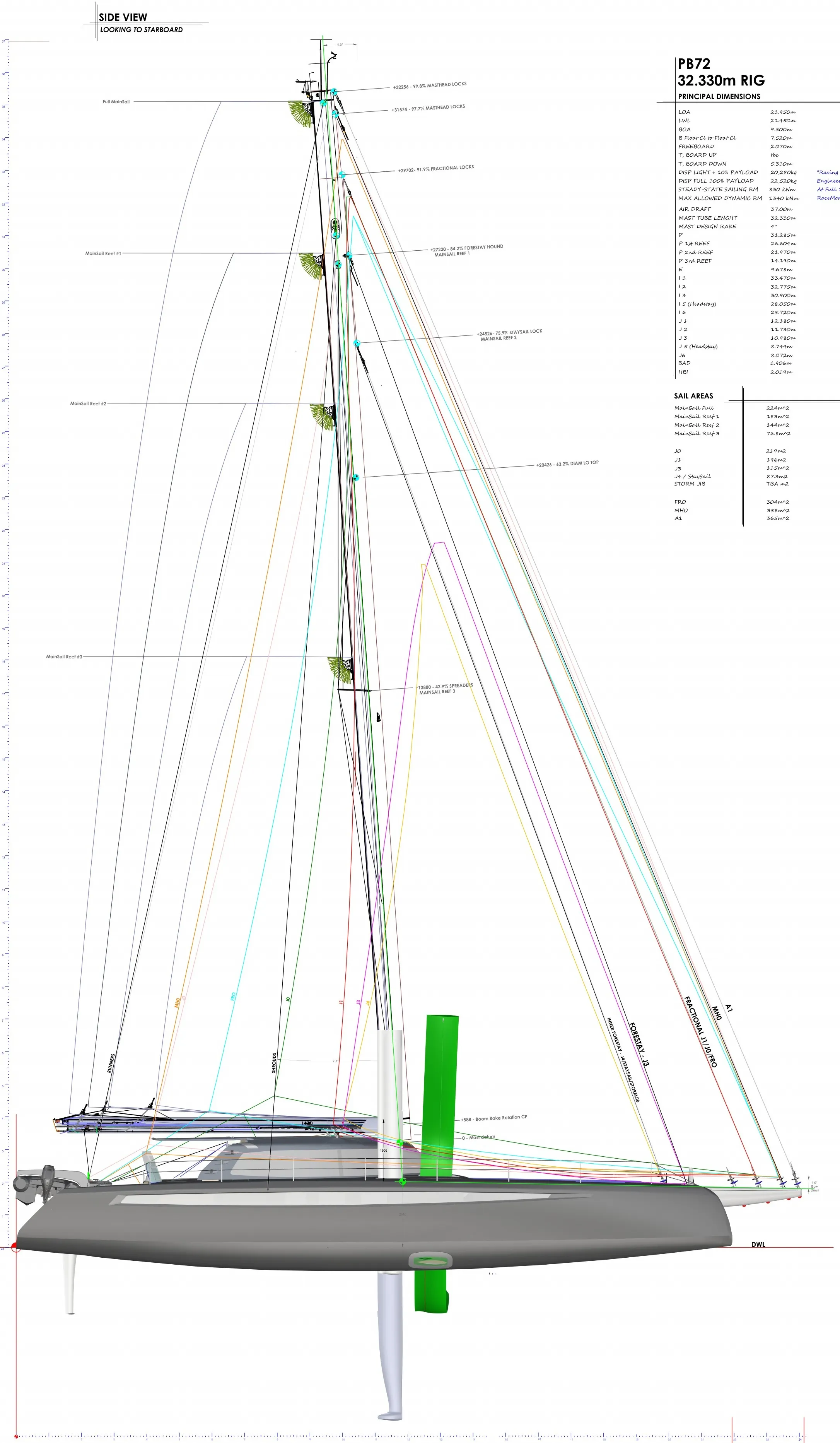
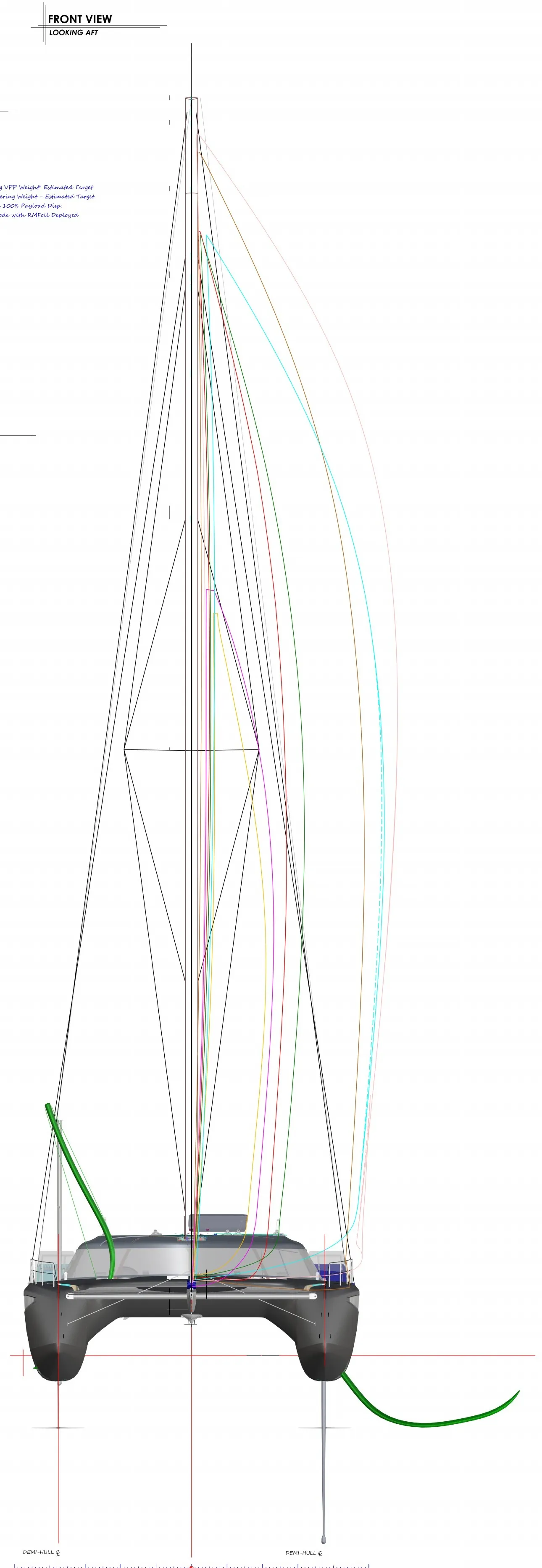
Morrelli & Melvin Design & Engineering · PB72_001 Rev A · 6 August 2022 · Reproduced with permission
Private enquiries
PB72 is in sea trials. Partnerships, racing programs, experiences and charter are discussed personally with our team.
Extreme H2O · Foiling ocean catamaran · Technical specification
PB72 specifications
Morrelli & Melvin · GA PB72_001 Rev A · Persico Marine build spec
- Length overall
- 21.95 m
- 72.0 ft
- Beam
- 9.50 m
- 31.2 ft
- Racing displacement
- ≈ 21.5 t
- As built · VPP targets at 20.3 t
- Mast
- 32.33 m
- Air draft 37 m
- Upwind sail area
- 420 m²
- Main 224 + J1 196
- Fastest upwind
- J3 + main
- Full main 224 + J3 115 m²
- Fastest downwind
- MHO + main
- Full main 224 + MHO 358 m²
- Predicted top speed
- 40+ kn
- VPP
Principal dimensions
- Length overall
- 21.95 m72.0 ft
- Length incl. longeron
- 24.10 m79.1 ft
- Length waterline
- 21.45 m70.4 ft
- Beam overall
- 9.50 m31.2 ft
- Hull centreline spacing
- 7.52 m24.7 ft
- Freeboard
- 2.07 m6.8 ft
- Draft, boards down
- 5.31 m17.4 ft
- Draft, foils raised
- 0.65 m2.1 ft
- Air draft
- 37.00 m121.4 ft
Displacement & stability
- Light displacement
- ≈ 21,000 kgAs built · design 20,500 kg
- Racing displacement
- ≈ 21,500 kgAs built · as sailed in sea trials
- VPP target displacement
- 20,280 kgDesign racing weight used for the polar targets
- Design displacement (mLDC)
- 23,047 kgMaximum load condition
- Max total load (ISO 8666)
- 22,518 kg
- Steady-state sailing RM
- 830 kNmAt full-payload displacement
- Max dynamic RM
- 1,340 kNmRace mode, RMFoil deployed
Rig
- Mast tube length
- 32.33 m106.1 ft
- Mast design rake
- 4°
- P
- 31.285 mReefs: 26.604 · 21.970 · 14.190 m
- E
- 9.678 m
- I (1 · 2 · 3)
- 33.470 · 32.775 · 30.900 m
- I headstay (5 · 6)
- 28.050 · 25.720 m
- J (1 · 2 · 3)
- 12.180 · 11.730 · 10.980 m
- J headstay (5 · 6)
- 8.744 · 8.072 m
- BAD · HBI
- 1.906 · 2.019 m
Sail areas
- Mainsail, full
- 224 m²Reefs: 183 · 144 · 76.8 m²
- J0
- 219 m²
- J1
- 196 m²
- J3
- 115 m²
- J4 / staysail
- 87.3 m²
- FRO
- 304 m²
- MHO
- 358 m²
- A1
- 365 m²
- Fastest upwind setup
- J3 + full mainJ1 in marginal upwind conditions, 13–14 kn: partial foiling
- Fastest downwind setup
- MHO + full main
Foils & flight control
- Righting-moment foil
- ≈ 16 × 3 ftCurved carbon foil in a hydraulically raked case
- Daggerboards
- Centreline, per hullIndependent of the lifting foil
- Rudders
- Raking, T-foilConical titanium bearings · ≈ 6 ft T-foils
- Flight control
- Designed for fly-by-wireFoil lift and rudder-elevator control; programmed after sea trials
Construction & class
- Hull
- Carbon fibreFoam & Nomex sandwich
- Superstructure
- Carbon fibreFoam & Nomex sandwich
- Classification
- ISO 12215-7 Cat. ASER1 multihull · highest category, sport boat
- Propulsion
- 2 × 35 kW electricTorqeedo
Rig & deck hardware
- Mast
- Carbon rotating wing mastSupplied by SSNZ · single spreader, double diamond, running backstays
- Primary winches
- 4 × Harken 1125.3
- Secondary winches
- 2 × Harken 65.3 ST
- Windlass
- Lewmar V6 hydraulic
Propulsion & power
- Main engines
- 2 × Torqeedo electric25 kW continuous · 35 kW max each
- Drive
- Shaft driveStrut and P-bracket · Gori GP20 folding propellers
- Motoring speed
- 9.2 kn max7.5 kn cruise (estimated)
- Generators
- 2 × 20 kW Fischer Panda
- Propulsion battery
- 40 kWh lithium-ionBMW i3 cells
- Solar
- 2 kWPanels on the coachroof
- Electrical
- 120 V and 240 V AC400 V DC charging & hydraulic bus · 24 V domestic · Empirbus digital switching
Tankage
- Fuel
- 2 × 550 L
- Fresh water
- 2 × 450 LPlus 70 L drinking water
- Watermaker
- Schenker Modular Zen 50
- Black water
- 2 × 220 L
Comfort & systems
- Air conditioning
- 64,000 BTU/hTermodinamica
- Galley
- Gaggenau hobsPizza oven · Miele microwave · Miele coffee machine
- Refrigeration
- 3 × 172 L fridgesPlus Frigonautica freezer
- Navigation
- B&G / Simrad
- Communications
- VHF · 5G · SatcomSatellite broadband
- Steering
- Outside helms + inside helmFly-by-wire steering at the inside helm station
Performance
- Predicted top speed
- 40+ knPolar peak 40.7 kn
- Foiling onset
- 11–13 kn TWSDepending on sail set
- Upwind, 13 kn of wind
- ≈ 24 kn
- Downwind, 14 kn of wind
- ≈ 31 kn
- Crew
- 4 per watchTo sail her fast; two watches for round-the-clock ocean racing
Velocity prediction program, partially validated in sea trials.
Design & build
- Naval architecture
- Morrelli & MelvinNewport Beach, California
- Lead designer
- Ferdinand van WestThen at Morrelli & Melvin; now Van West Naval Architecture
- Interior architecture
- Design Unlimited
- Builder
- Persico MarineItaly
- Flight control
- Team New Zealand engineers
- General arrangement
- PB72_001 · Rev A6 August 2022
Figures from the Morrelli & Melvin general arrangement (PB72_001, Rev A, August 2022) and the Persico Marine build specification. Displacements are approximate as-built figures from Ferdinand van West (2026); righting moments are design estimates; performance figures are VPP predictions, calculated at the 20,280 kg design racing displacement.
Every cell is a predicted boat speed from the velocity prediction program. The circled cells are the targets PB72 has already hit in her first sea trials, with the foils still trimmed by hand. Each one came in on target.
| Wind angleTrue wind (kn) | 5 | 6 | 7 | 8 | 9 | 10 | 11 | 12 | 13 | 14 | 15 | 16 | 18 | 20 | 22 | 24 |
|---|---|---|---|---|---|---|---|---|---|---|---|---|---|---|---|---|
| 45° | 7.6 | 8.4 | 9.1 | 9.8 | 10.4 | 11.3 | 12.6 | 13.6 | 14.4 | 15.1 | 16.0 | 17.4 | 20.5 | 23.4 | 24.0 | 23.7 |
| 50° | 8.0 | 8.9 | 9.7 | 10.5 | 11.2 | 12.8 | 14.3 | 15.1 | 16.3 | 17.6 | 19.5 | 21.6 | 27.1 | 27.5 | 27.0 | 26.5 |
| 55° | 8.4 | 9.3 | 10.2 | 11.2 | 12.2 | 14.2 | 15.7 | 17.0 | 18.8 | 20.8 | 23.4 | 27.6 | 30.1 | 30.2 | 29.5 | 28.9 |
| 60° | 8.8 | 9.7 | 10.7 | 11.8 | 13.2 | 15.3 | 17.1 | 19.3 | 21.5 | 26.1 | 28.6 | 30.2 | 32.4 | 32.3 | 31.6 | 30.9 |
| 65° | 9.1 | 10.1 | 11.2 | 12.3 | 14.3 | 16.4 | 19.1 | 21.5 | 26.1 | 29.0 | 30.8 | 32.2 | 34.3 | 34.2 | 33.4 | 32.4 |
| 70° | 9.3 | 10.4 | 11.5 | 12.7 | 14.9 | 17.9 | 20.9 | 24.1 | 28.6 | 30.8 | 32.4 | 33.8 | 35.8 | 35.7 | 34.8 | 32.3 |
| 75° | 9.5 | 10.6 | 11.8 | 13.1 | 15.4 | 19.4 | 22.6 | 27.3 | 30.2 | 32.2 | 33.7 | 35.1 | 37.1 | 37.1 | 36.2 | 34.0 |
| 80° | 9.7 | 11.0 | 12.3 | 13.9 | 15.8 | 20.6 | 25.1 | 28.7 | 31.4 | 33.2 | 34.7 | 36.1 | 38.1 | 38.2 | 37.3 | 36.2 |
| 85° | 9.8 | 11.2 | 12.6 | 14.2 | 16.2 | 21.3 | 26.9 | 29.8 | 32.2 | 34.0 | 35.5 | 36.9 | 39.0 | 39.1 | 38.3 | 37.5 |
| 90° | 9.9 | 11.3 | 12.7 | 14.4 | 16.4 | 21.5 | 27.7 | 31.5 | 33.5 | 35.1 | 36.3 | 37.5 | 39.6 | 39.8 | 39.1 | 38.7 |
| 95° | 9.9 | 11.3 | 12.8 | 14.4 | 16.5 | 21.0 | 28.7 | 31.7 | 33.9 | 35.5 | 36.8 | 37.9 | 40.0 | 40.3 | 39.8 | 39.5 |
| 100° | 9.9 | 11.3 | 12.7 | 14.2 | 16.3 | 22.3 | 28.8 | 31.7 | 34.2 | 35.8 | 37.0 | 38.1 | 40.3 | 40.6 | 40.3 | 40.0 |
| 105° | 9.8 | 11.1 | 12.5 | 14.0 | 15.7 | 21.0 | 28.3 | 31.4 | 34.0 | 35.8 | 37.1 | 38.2 | 40.3 | 40.7 | 40.5 | 40.3 |
| 110° | 9.7 | 10.9 | 12.2 | 13.6 | 15.1 | 17.7 | 26.8 | 31.0 | 33.3 | 35.5 | 37.0 | 38.2 | 40.2 | 40.7 | 40.6 | 40.4 |
| 115° | 9.5 | 10.6 | 11.8 | 13.1 | 14.5 | 16.5 | 19.9 | 30.0 | 32.6 | 34.8 | 36.6 | 37.9 | 40.0 | 40.3 | 40.4 | 40.1 |
| 120° | 9.2 | 10.3 | 11.4 | 12.5 | 13.7 | 14.9 | 17.4 | 25.8 | 31.8 | 34.0 | 35.6 | 37.4 | 39.6 | 40.0 | 40.0 | 39.6 |
| 125° | 8.9 | 9.9 | 10.8 | 11.6 | 12.4 | 13.5 | 14.7 | 16.3 | 29.7 | 32.9 | 34.9 | 36.4 | 39.0 | 39.6 | 39.6 | 39.1 |
| 130° | 8.5 | 9.4 | 10.0 | 10.8 | 11.9 | 13.1 | 14.3 | 15.5 | 17.1 | 18.0 | 33.4 | 35.4 | 38.1 | 38.9 | 39.1 | 38.6 |
| 135° | 8.2 | 8.7 | 9.5 | 10.5 | 11.5 | 12.6 | 13.7 | 14.8 | 16.2 | 17.3 | 18.4 | 20.0 | 37.0 | 38.0 | 38.2 | 37.7 |
| 140° | 7.6 | 8.2 | 9.1 | 9.9 | 10.9 | 11.9 | 12.9 | 14.0 | 15.2 | 16.4 | 17.7 | 19.1 | 22.1 | 35.4 | 30.7 | 35.0 |
Predicted speeds from the velocity prediction program. Sea-trial targets achieved with manual foil trim; the automatic flight-control system comes online after calibration.
- VPP targets calculated at
- 20,280 kg
- Design racing displacement
- Sea trials sailed at
- ≈ 21,500 kg
- As-built racing displacement
Every circled target was reached with the boat about 1.2 tonnes heavier than the weight the predictions assume.