Racing · Turnkey racing program
You race.
We handle
the rest.
Grand-prix offshore racing at the top of the sport, now being shaped with its first owners and partners. The whole crew is aboard to race: one of our experienced crew usually helms, and experienced sailors can take the wheel themselves.
“Ferraris are very powerful cars, and they sell them to total amateur drivers.”
Who it’s for
Grand-prix racing,
without the long build
Commissioning a foiling yacht takes two or three years. PB72 is already built, launched and sailing in sea trials. Once those are complete, the program could put you on the start line of the world’s great offshore races in a fraction of the time.
It is built for owners, guests and corporate team principals who want to experience grand-prix multihull racing and record attempts at the highest level, and who value their time more than owning the boat outright. Many already own a cruising superyacht and want a separate racing program; others are deciding whether to commission a foiling yacht of their own.
For them, PB72 is also a proving ground. Her design can be shared and Persico Marine holds the molds, so a season aboard can be the first step towards a sister ship.
On race days the whole crew is there to win. One of our experienced crew members will usually take the helm, with you racing as part of the team. If you are an experienced sailor, you can drive her yourself, with coaching from the crew who know her best.
What’s included
Everything,
except the helm
- 01Program managementA dedicated campaign manager, season plan, budget and objectives set race by race.
- 02Professional crewA permanent core of boat captain, flight-control specialist, trimmers and bowman, plus specialist race crew for each event, cross-trained in rigging, hydraulics, composites and electronics.
- 03Racing supportTactician, navigator and weather router, a performance analyst for foil and flight-control data, and a chase RIB.
- 04Helm & trim coachingFor experienced sailors who want to drive: helm coaching, flight-control training on ride height and foil rake, boat-handling drills, and video and data debriefs after every session.
- 05TrainingA pre-season training block, practice days before each event, and simulator and data-review sessions ashore.
- 06LogisticsTeam housing, travel and catering, and container logistics for sails, spares and the workshop.
- 07TransportationDelivery by sea or ship, customs and cruising permits, cranage and haul-out, with specialist shipping for a 9.5 m beam.
- 08MaintenanceDaily rig and systems checks, a foil and appendage inspection regime, composite and hydraulic specialists, winter refit and care between events.
- 09Event managementEntries, rating certificates (ORR, IRC, MOCRA), measurement, berths, offshore safety compliance and the social calendar.
- 10HospitalityGuest racing berths, a spectator chase boat, a dockside team base and owners’ dinners.
- 11Media & sponsorshipOnboard cameras, drone and documentary content, branding on sails and hull, partner hospitality and integration at events.
The crew
Professionals
at every station
The core crew live with the boat. They know every hydraulic line, every foil setting and every sail in the inventory. They bring that knowledge to every race, so the owner can focus on driving.
Specialist race crew join for each event, chosen for the course: offshore navigators for ocean races, round-the-buoys tacticians for regattas.
Built to chase
line honours
Racing program
Private enquiries
PB72 is in sea trials. Partnerships, racing programs, experiences and charter are discussed personally with our team.
Extreme H2O · Foiling ocean catamaran · Technical specification
PB72 specifications
Morrelli & Melvin · GA PB72_001 Rev A · Persico Marine build spec
- Length overall
- 21.95 m
- 72.0 ft
- Beam
- 9.50 m
- 31.2 ft
- Racing displacement
- ≈ 21.5 t
- As built · VPP targets at 20.3 t
- Mast
- 32.33 m
- Air draft 37 m
- Upwind sail area
- 420 m²
- Main 224 + J1 196
- Fastest upwind
- J3 + main
- Full main 224 + J3 115 m²
- Fastest downwind
- MHO + main
- Full main 224 + MHO 358 m²
- Predicted top speed
- 40+ kn
- VPP
Principal dimensions
- Length overall
- 21.95 m72.0 ft
- Length incl. longeron
- 24.10 m79.1 ft
- Length waterline
- 21.45 m70.4 ft
- Beam overall
- 9.50 m31.2 ft
- Hull centreline spacing
- 7.52 m24.7 ft
- Freeboard
- 2.07 m6.8 ft
- Draft, boards down
- 5.31 m17.4 ft
- Draft, foils raised
- 0.65 m2.1 ft
- Air draft
- 37.00 m121.4 ft
Displacement & stability
- Light displacement
- ≈ 21,000 kgAs built · design 20,500 kg
- Racing displacement
- ≈ 21,500 kgAs built · as sailed in sea trials
- VPP target displacement
- 20,280 kgDesign racing weight used for the polar targets
- Design displacement (mLDC)
- 23,047 kgMaximum load condition
- Max total load (ISO 8666)
- 22,518 kg
- Steady-state sailing RM
- 830 kNmAt full-payload displacement
- Max dynamic RM
- 1,340 kNmRace mode, RMFoil deployed
Rig
- Mast tube length
- 32.33 m106.1 ft
- Mast design rake
- 4°
- P
- 31.285 mReefs: 26.604 · 21.970 · 14.190 m
- E
- 9.678 m
- I (1 · 2 · 3)
- 33.470 · 32.775 · 30.900 m
- I headstay (5 · 6)
- 28.050 · 25.720 m
- J (1 · 2 · 3)
- 12.180 · 11.730 · 10.980 m
- J headstay (5 · 6)
- 8.744 · 8.072 m
- BAD · HBI
- 1.906 · 2.019 m
Sail areas
- Mainsail, full
- 224 m²Reefs: 183 · 144 · 76.8 m²
- J0
- 219 m²
- J1
- 196 m²
- J3
- 115 m²
- J4 / staysail
- 87.3 m²
- FRO
- 304 m²
- MHO
- 358 m²
- A1
- 365 m²
- Fastest upwind setup
- J3 + full mainJ1 in marginal upwind conditions, 13–14 kn: partial foiling
- Fastest downwind setup
- MHO + full main
Foils & flight control
- Righting-moment foil
- ≈ 16 × 3 ftCurved carbon foil in a hydraulically raked case
- Daggerboards
- Centreline, per hullIndependent of the lifting foil
- Rudders
- Raking, T-foilConical titanium bearings · ≈ 6 ft T-foils
- Flight control
- Designed for fly-by-wireFoil lift and rudder-elevator control; programmed after sea trials
Construction & class
- Hull
- Carbon fibreFoam & Nomex sandwich
- Superstructure
- Carbon fibreFoam & Nomex sandwich
- Classification
- ISO 12215-7 Cat. ASER1 multihull · highest category, sport boat
- Propulsion
- 2 × 35 kW electricTorqeedo
Rig & deck hardware
- Mast
- Carbon rotating wing mastSupplied by SSNZ · single spreader, double diamond, running backstays
- Primary winches
- 4 × Harken 1125.3
- Secondary winches
- 2 × Harken 65.3 ST
- Windlass
- Lewmar V6 hydraulic
Propulsion & power
- Main engines
- 2 × Torqeedo electric25 kW continuous · 35 kW max each
- Drive
- Shaft driveStrut and P-bracket · Gori GP20 folding propellers
- Motoring speed
- 9.2 kn max7.5 kn cruise (estimated)
- Generators
- 2 × 20 kW Fischer Panda
- Propulsion battery
- 40 kWh lithium-ionBMW i3 cells
- Solar
- 2 kWPanels on the coachroof
- Electrical
- 120 V and 240 V AC400 V DC charging & hydraulic bus · 24 V domestic · Empirbus digital switching
Tankage
- Fuel
- 2 × 550 L
- Fresh water
- 2 × 450 LPlus 70 L drinking water
- Watermaker
- Schenker Modular Zen 50
- Black water
- 2 × 220 L
Comfort & systems
- Air conditioning
- 64,000 BTU/hTermodinamica
- Galley
- Gaggenau hobsPizza oven · Miele microwave · Miele coffee machine
- Refrigeration
- 3 × 172 L fridgesPlus Frigonautica freezer
- Navigation
- B&G / Simrad
- Communications
- VHF · 5G · SatcomSatellite broadband
- Steering
- Outside helms + inside helmFly-by-wire steering at the inside helm station
Performance
- Predicted top speed
- 40+ knPolar peak 40.7 kn
- Foiling onset
- 11–13 kn TWSDepending on sail set
- Upwind, 13 kn of wind
- ≈ 24 kn
- Downwind, 14 kn of wind
- ≈ 31 kn
- Crew
- 4 per watchTo sail her fast; two watches for round-the-clock ocean racing
Velocity prediction program, partially validated in sea trials.
Design & build
- Naval architecture
- Morrelli & MelvinNewport Beach, California
- Lead designer
- Ferdinand van WestThen at Morrelli & Melvin; now Van West Naval Architecture
- Interior architecture
- Design Unlimited
- Builder
- Persico MarineItaly
- Flight control
- Team New Zealand engineers
- General arrangement
- PB72_001 · Rev A6 August 2022
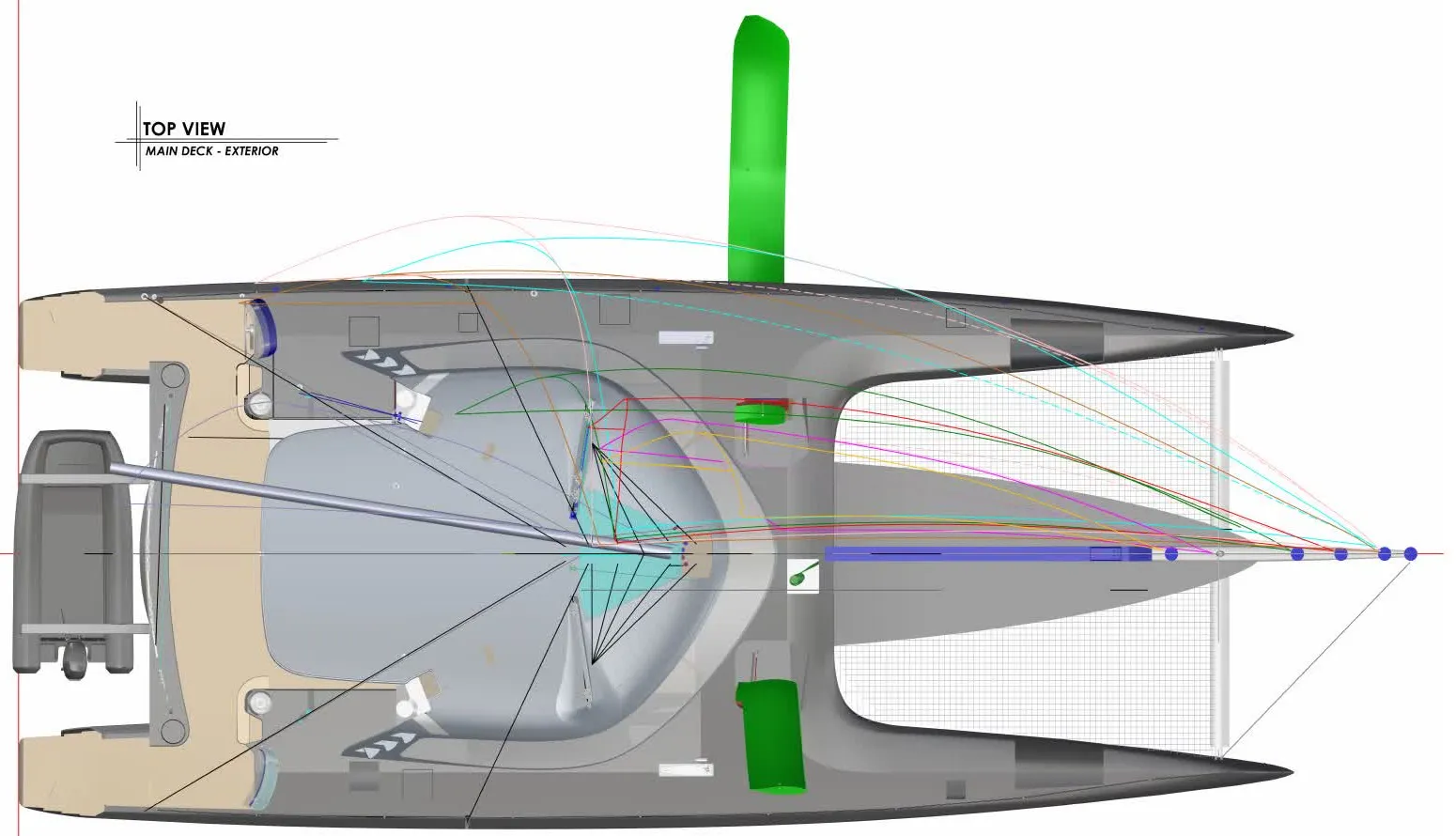
Figures from the Morrelli & Melvin general arrangement (PB72_001, Rev A, August 2022) and the Persico Marine build specification. Displacements are approximate as-built figures from Ferdinand van West (2026); righting moments are design estimates; performance figures are VPP predictions, calculated at the 20,280 kg design racing displacement.
Every cell is a predicted boat speed from the velocity prediction program. The circled cells are the targets PB72 has already hit in her first sea trials, with the foils still trimmed by hand. Each one came in on target.
| Wind angleTrue wind (kn) | 5 | 6 | 7 | 8 | 9 | 10 | 11 | 12 | 13 | 14 | 15 | 16 | 18 | 20 | 22 | 24 |
|---|---|---|---|---|---|---|---|---|---|---|---|---|---|---|---|---|
| 45° | 7.6 | 8.4 | 9.1 | 9.8 | 10.4 | 11.3 | 12.6 | 13.6 | 14.4 | 15.1 | 16.0 | 17.4 | 20.5 | 23.4 | 24.0 | 23.7 |
| 50° | 8.0 | 8.9 | 9.7 | 10.5 | 11.2 | 12.8 | 14.3 | 15.1 | 16.3 | 17.6 | 19.5 | 21.6 | 27.1 | 27.5 | 27.0 | 26.5 |
| 55° | 8.4 | 9.3 | 10.2 | 11.2 | 12.2 | 14.2 | 15.7 | 17.0 | 18.8 | 20.8 | 23.4 | 27.6 | 30.1 | 30.2 | 29.5 | 28.9 |
| 60° | 8.8 | 9.7 | 10.7 | 11.8 | 13.2 | 15.3 | 17.1 | 19.3 | 21.5 | 26.1 | 28.6 | 30.2 | 32.4 | 32.3 | 31.6 | 30.9 |
| 65° | 9.1 | 10.1 | 11.2 | 12.3 | 14.3 | 16.4 | 19.1 | 21.5 | 26.1 | 29.0 | 30.8 | 32.2 | 34.3 | 34.2 | 33.4 | 32.4 |
| 70° | 9.3 | 10.4 | 11.5 | 12.7 | 14.9 | 17.9 | 20.9 | 24.1 | 28.6 | 30.8 | 32.4 | 33.8 | 35.8 | 35.7 | 34.8 | 32.3 |
| 75° | 9.5 | 10.6 | 11.8 | 13.1 | 15.4 | 19.4 | 22.6 | 27.3 | 30.2 | 32.2 | 33.7 | 35.1 | 37.1 | 37.1 | 36.2 | 34.0 |
| 80° | 9.7 | 11.0 | 12.3 | 13.9 | 15.8 | 20.6 | 25.1 | 28.7 | 31.4 | 33.2 | 34.7 | 36.1 | 38.1 | 38.2 | 37.3 | 36.2 |
| 85° | 9.8 | 11.2 | 12.6 | 14.2 | 16.2 | 21.3 | 26.9 | 29.8 | 32.2 | 34.0 | 35.5 | 36.9 | 39.0 | 39.1 | 38.3 | 37.5 |
| 90° | 9.9 | 11.3 | 12.7 | 14.4 | 16.4 | 21.5 | 27.7 | 31.5 | 33.5 | 35.1 | 36.3 | 37.5 | 39.6 | 39.8 | 39.1 | 38.7 |
| 95° | 9.9 | 11.3 | 12.8 | 14.4 | 16.5 | 21.0 | 28.7 | 31.7 | 33.9 | 35.5 | 36.8 | 37.9 | 40.0 | 40.3 | 39.8 | 39.5 |
| 100° | 9.9 | 11.3 | 12.7 | 14.2 | 16.3 | 22.3 | 28.8 | 31.7 | 34.2 | 35.8 | 37.0 | 38.1 | 40.3 | 40.6 | 40.3 | 40.0 |
| 105° | 9.8 | 11.1 | 12.5 | 14.0 | 15.7 | 21.0 | 28.3 | 31.4 | 34.0 | 35.8 | 37.1 | 38.2 | 40.3 | 40.7 | 40.5 | 40.3 |
| 110° | 9.7 | 10.9 | 12.2 | 13.6 | 15.1 | 17.7 | 26.8 | 31.0 | 33.3 | 35.5 | 37.0 | 38.2 | 40.2 | 40.7 | 40.6 | 40.4 |
| 115° | 9.5 | 10.6 | 11.8 | 13.1 | 14.5 | 16.5 | 19.9 | 30.0 | 32.6 | 34.8 | 36.6 | 37.9 | 40.0 | 40.3 | 40.4 | 40.1 |
| 120° | 9.2 | 10.3 | 11.4 | 12.5 | 13.7 | 14.9 | 17.4 | 25.8 | 31.8 | 34.0 | 35.6 | 37.4 | 39.6 | 40.0 | 40.0 | 39.6 |
| 125° | 8.9 | 9.9 | 10.8 | 11.6 | 12.4 | 13.5 | 14.7 | 16.3 | 29.7 | 32.9 | 34.9 | 36.4 | 39.0 | 39.6 | 39.6 | 39.1 |
| 130° | 8.5 | 9.4 | 10.0 | 10.8 | 11.9 | 13.1 | 14.3 | 15.5 | 17.1 | 18.0 | 33.4 | 35.4 | 38.1 | 38.9 | 39.1 | 38.6 |
| 135° | 8.2 | 8.7 | 9.5 | 10.5 | 11.5 | 12.6 | 13.7 | 14.8 | 16.2 | 17.3 | 18.4 | 20.0 | 37.0 | 38.0 | 38.2 | 37.7 |
| 140° | 7.6 | 8.2 | 9.1 | 9.9 | 10.9 | 11.9 | 12.9 | 14.0 | 15.2 | 16.4 | 17.7 | 19.1 | 22.1 | 35.4 | 30.7 | 35.0 |
Predicted speeds from the velocity prediction program. Sea-trial targets achieved with manual foil trim; the automatic flight-control system comes online after calibration.
- VPP targets calculated at
- 20,280 kg
- Design racing displacement
- Sea trials sailed at
- ≈ 21,500 kg
- As-built racing displacement
Every circled target was reached with the boat about 1.2 tonnes heavier than the weight the predictions assume.